Many habits that children acquire during their first years of life seem completely normal. However, when they continue for longer than recommended, they can alter the growth of teeth and jaws, and even affect breathing, speech, or bite.
In MIDSA Dentistry, As specialists in pediatric dentistry and children's orthodontics in Valencia, we frequently see problems that could have been avoided with early detection.
In this article we tell you what the most frequent oral habits are, when they stop being normal and what you can do to prevent future complications.
What are bad oral habits?
Bad oral habits are repetitive behaviors that affect the proper development of the mouth and facial structures.
Although many are part of a child's normal development, keeping them for too long can cause problems that later require orthodontic treatment.
That's why it's important to have regular checkups with a pediatric dentist, even if the teeth look healthy.
1. Sucking your thumb
It is probably the most well-known habit.
During the first few years of life, this can be completely normal, as it provides security and calm for the baby. However, if it continues after 3-4 years of age, it increases the risk of developing:
- Open bite.
- Upper teeth pointing forward.
- Narrow palate.
- Changes in tongue position.
- Pronunciation problems.
The sooner the habit disappears, the greater the chances that growth will return to normal without the need for complex treatments.
2. Prolonged use of a pacifier
A pacifier can be a great help during the first few months, but keeping it for too long can produce effects similar to thumb sucking.
Experts recommend gradually removing it around 2-3 years of age.
Prolonged use benefits:
- Open bite.
- Alterations in the position of the teeth.
- Changes in jaw growth.
- Greater need for orthodontics in the future.
3. Breathing through the mouth
Many parents believe that breathing through the mouth is simply a habit.
In reality, it is usually the consequence of some problem such as:
- Allergies.
- Enlarged adenoids.
- Nasal obstruction.
- Septal deviation.
Prolonged mouth breathing can affect facial development and cause:
- Narrow palate.
- Crossbite.
- Longer face.
- Snoring.
- Worse night's sleep.
In addition, the mouth remains drier, increasing the risk of cavities and gingivitis.
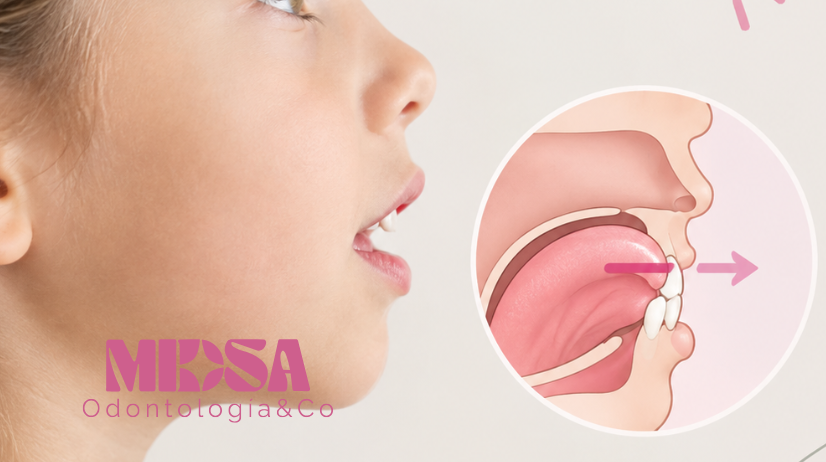
4. Push your teeth with your tongue
The call atypical swallowing It's more common than it seems.
During swallowing, the tongue pushes the teeth forward instead of resting properly against the palate.
Over the years it can produce:
- Gaps between teeth.
- Open bite.
- Relapse after orthodontics.
- Difficulties with some sounds.
In many cases it is necessary to combine orthodontics with myofunctional therapy.
5. Constantly biting objects
Pencils, toys, fingernails, clothing sleeves, or even the collar of t-shirts.
Although it may seem like a trivial gesture, repeating it continuously can cause:
- Tooth wear.
- Small fractures.
- Mandibular overload.
- Bite abnormalities.
In addition, it promotes the entry of bacteria into the mouth.
6. Biting your nails
Onychophagia is very common during childhood.
In addition to the risk of infections, it can cause:
- Dental microfractures.
- Enamel wear.
- Tension in the temporomandibular joint (TMJ).
- Bite changes if the habit is intense.
7. Always sleeping with your mouth open
It often goes unnoticed.
If your child habitually sleeps with their mouth open, it may indicate breathing problems that should be evaluated as soon as possible.
It is also common to observe:
- Dry lips.
- Bad breath.
- Unrefreshing sleep.
- Greater predisposition to cavities.
How can you tell if a habit is affecting your mouth?
Some warning signs are:
- The teeth begin to separate.
- The bite doesn't fit correctly.
- The child breathes through his mouth.
- He snores frequently.
- He has difficulty speaking some sounds.
- Maintains habits beyond 3-4 years.
- Permanent teeth erupt in abnormal positions.
If any of these signs appear, it is advisable to have a check-up.
Can these problems be corrected?
Yes. The earlier they are detected, the simpler the treatment usually is.
Depending on each case, the following may be recommended:
- Gradual elimination of the habit.
- Periodic reviews.
- Myofunctional therapy.
- Palatal expansion.
- Interceptive orthodontics.
- Orthodontics invisible children when indicated.
Prevention is always easier than correcting problems that have already been established.
The importance of childhood checkups
Many bite problems do not cause pain and go unnoticed for years.
That's why regular check-ups allow growth abnormalities to be detected when they can still be corrected much more easily.
In MIDSA Dentistry, In Valencia, we accompany children at every stage of their development to achieve a healthy smile from a young age and avoid more complex treatments in the future.
Conclusion
Habits such as thumb sucking, using a pacifier for too long, mouth breathing, or biting objects may seem harmless, but when maintained they can influence the development of the mouth and the position of the teeth.
Detecting them early and attending regular checkups with a pediatric dentist is the best way to prevent future problems and promote healthy growth.