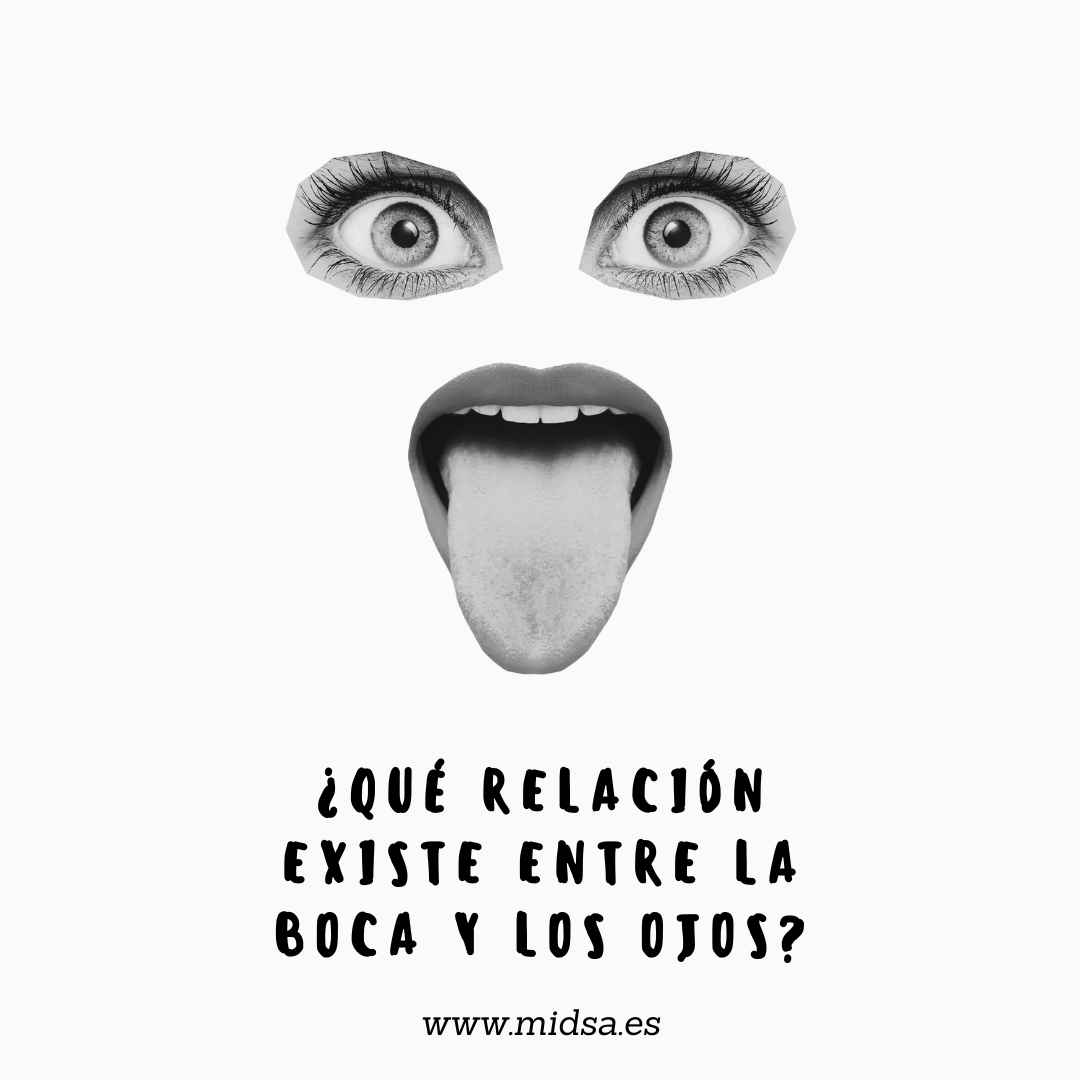
The relationship between the eyes and the mouth is a surprise to patients; some patients find relief from their instability or headaches when the orthodontist restores good occlusal contact or when we relax the masticatory muscles or improve the position of the TMJ.
There is evidence of a relationship between occlusion and posture; alterations in the body's muscular balance can influence jaw position and facial morphology. We also know that changes in mandibular position can influence cervical muscles and the posture of the neck, head, and the rest of the body. The mouth is fundamental for the mechanical and neurological balance of the cervical spine, the skull, and especially the eyes.
The mouth is a crucial input point for the postural system. It provides two important types of information. On the one hand, it contributes proprioceptive information from the temporomandibular muscles and joints, and on the other hand, it provides exteroceptive information from occlusal contact. In both cases, the information from the mouth is simultaneously information from the cranium. The mandible articulates with the cranium, and any masticatory muscle or occlusal contact indicates how and in what way the cranium is positioned in space. Every structure that provides information about head position is fundamental to the postural system. The nervous system uses this information from the mouth, along with that from the vestibular system, vision, and cervical and ocular proprioception, to control posture and balance.
The oculomotor system and the stomatognathic system are connected, not only by mechanical structures, but also because both systems are innervated by the trigeminal nerve.
Neurologically, Both the eyes and the mouth are innervated by the Fifth cranial nerve or Trigeminal nerve. This is a mixed nerve because it has motor fibers, which are involved in chewing, and sensory fibers, which innervate part of the face. At the level of the trigeminal ganglion, it divides into three branches:
-
- Ophthalmic branch (V1): Fully sensitive. It innervates the eyeball, the lacrimal gland, the skin of the nose, the forehead, the eyelids, the nasal mucosa and part of the scalp.
-
- Maxillary branch (V2): It is also purely sensory. It innervates the lower eyelids, the wings of the nose, the lacrimal gland, the palate, and the upper teeth. This is a branch that relates directly part of the eye with the maxillary area.
-
- Mandibular branch (V3): It is a mixed or sensorimotor nerve. It innervates the meninges, temples, jaw, lower teeth, and tongue.
Studies show a strong relationship between occlusal, muscular, or articular alterations in the mouth and the decompensation of an oculomotor pathology.
In pathologies such as malocclusions (crossbites, open bites, etc.), missing teeth, or temporomandibular joint dysfunction, a permanent state of imbalance is present. This requires a collaborative approach among specialists to guarantee success.
In summary
The mouth is part of a craniocervicomandibular system and has a great influence on the cervical spine and head position.
The mouth is also an important postural sensor. Information from the temporomandibular joint (TMJ), the masticatory muscles, and the periodontal ligaments—in other words, all trigeminal information—reaches nerve centers in the brainstem linked to postural control. Through the medial longitudinal fasciculus, trigeminal information connects with the oculomotor nuclei, so evidence of an oculomotor problem can destabilize an existing oculomotor disorder.
Bibliography: Manual therapy of the oculomotor system